
Travel the World with Us—Learners in Greece Love Thea!
- Jul 29, 2025
- 4 min read
Updated: Sep 2, 2025
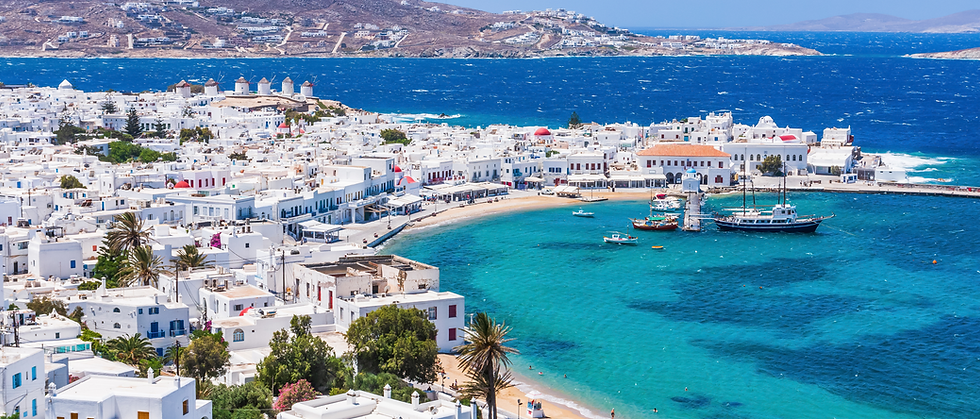
Greece is a country where the past never really feels that far away. Walk through a modern city like Athens or Thessaloniki, and you’ll pass ancient ruins nestled between coffee shops and bookstores. Venture to the islands and you’ll find sunsets over whitewashed houses and quiet fishing villages that haven’t changed much in decades. But Greece is a place with deep roots, a proud culture, and a long tradition of thinking, storytelling, and learning.
History
The story of Greece is one of the longest and most influential in the world. It begins in the Bronze Age, with the Minoans on the island of Crete and the Mycenaeans on the mainland. These early civilizations built palaces, developed trade networks, and left behind rich archaeological sites like Knossos and Mycenae—reminders of a time when pre-Greek culture was thriving long before the rise of classical Athens.
Fast forward a few centuries, and the fragmented city-states of Ancient Greece begin to take shape. Places like Athens, Sparta, Corinth, and Delphi each had their own governments, values, and rivalries. Athens stood out as a center for democracy, philosophy, and the arts. Citizens gathered to debate, vote, and shape policy; an early version of the democratic principles many countries follow today.
This was also the age of some of the most lasting works of thought and literature. Socrates, often seen as the father of Western philosophy, wandered the streets of Athens asking uncomfortable questions. His student, Plato, wrote dialogues that explored justice, love, and politics. Plato’s student, Aristotle, laid the groundwork for logic, biology, and ethics—his influence still felt in modern classrooms.
At the same time, Greek literature flourished. Homer’s Iliad and Odyssey gave us epic heroes, moral dilemmas, and the shape of ancient Greek values. Later playwrights like Euripides, Sophocles, and Aeschylus brought complex characters to the stage, exploring war, fate, grief, and human nature through drama.
In the 4th century BCE, Alexander the Great, trained by Aristotle himself, built an empire stretching from Greece to Egypt and as far east as India. Greek language and culture spread across continents, blending with others in what became known as the Hellenistic world.
Greece eventually came under Roman, then Byzantine, and later Ottoman rule. Each era left its fingerprint—churches built on ancient temples, Arabic and Turkish words woven into the language; traditions layered over time. Greece fought for and gained its independence in the early 19th century, and by the 20th century it had become a modern nation with one foot firmly planted in its ancient heritage.
Today, Greece is part of the European Union and remains a global hallmark of culture, history, and philosophy.
Greek Mythology
Greek mythology is one of the country’s most iconic contributions. These myths were the Greek’s way of understanding everything from natural disasters to personal struggles.
The ancient Greeks imagined a world ruled by gods who lived on Mount Olympus, each with their own personalities, flaws, and powers. Zeus hurled lightning, Athena guided wisdom and war, Apollo inspired art and healing, and Aphrodite stirred up love and chaos. The stories of Persephone and Hades, Odysseus’s long journey home, or Icarus flying too close to the sun are still told today because they’re as entertaining as they are relatable to human experiences.
Greek myths influence everything from modern psychology (the Oedipus complex) to space exploration (hello, Apollo missions) and pop culture. And the places connected to them—Delphi, Crete, Naxos, Mount Olympus—still draw visitors curious to walk the same ground where gods and heroes once lived in imagination.
The Flavors of Greece
Greek food is all about balance: fresh ingredients, bold flavors, and a focus on sharing meals with others. It’s healthy without trying too hard, comforting without being heavy, and tied deeply to the seasons and the land.
At the heart of many dishes is olive oil, often made locally and used generously. Horiatiki (village salad) is a must-have—ripe tomatoes, cucumbers, onion, Kalamata olives, and a slab of feta, drizzled with oil and oregano.
You’ll find souvlaki stands on most corners, serving grilled meat wrapped in warm pita with tzatziki. Moussaka is a classic baked dish made with layers of eggplant, spiced meat, and creamy béchamel. Spanakopita, the flaky spinach and feta pie, is perfect any time of day.
On the islands and in coastal towns, seafood reigns. Grilled octopus, fried calamari, and fresh fish with lemon and herbs are everyday fare. In the mountains, you’ll find dishes built around goat cheese, beans, and slow-roasted meats.
For dessert, there’s baklava, dripping with honey and nuts, loukoumades (honey puffs), and galaktoboureko (custard in crispy filo). Coffee is strong and sipped slowly. And when it’s time to celebrate (or just unwind) many turn to a glass of ouzo or tsipouro, often accompanied by laughter and a full table.
Travel
Greece is one of the most travel-worthy countries on earth. No matter what you're into— ancient ruins, island hopping, mountain hiking, or enjoying a coastal town, there's no shortage of places to explore.
In Athens, the Acropolis rises over the city, a reminder of its long history. The Parthenon, the Agora, and the Acropolis Museum make for a steep dip into the past, while the city's modern cafés and neighborhoods keep it very much alive.
Take a ferry to Santorini for whitewashed buildings, volcanic cliffs, and sunsets that really are as good as they say. Mykonos is known for its beaches and nightlife, while Naxos and Paros offer a quieter island vibe with diverse landscapes and hidden beaches.
Crete, Greece’s largest island, is a world unto itself—ancient ruins at Knossos, dramatic gorges like Samaria, and food that you won't forget. In the north, Thessaloniki mixes Byzantine churches with great street food and an abundance of museums.
And if you’re up for something more remote, Meteora offers monasteries perched on towering rock columns, and Epirus or Pelion are perfect for mountain trails, stone villages, and forests that feel like something out of myth.
Back to Thea
Greece has long been a champion of knowledge. This month, we’re celebrating its lasting contributions to philosophy, literature, and science. But, we’re also acknowledging the students who carry forward its deep-rooted tradition of learning and curiosity.
If you're a student in Greece using Thea, we’d love to hear how it’s helped you. You're part of a long tradition of learners, and we’re proud to support you—every step of the way!
Travel programs that combine education with global exploration provide a unique and enriching experience for students. Learning in different cultural settings helps broaden perspectives and build confidence. Many participants also consider Management Courses in Cairo, Egypt to complement their international exposure with practical management knowledge...